
At Your Leisure - Archery
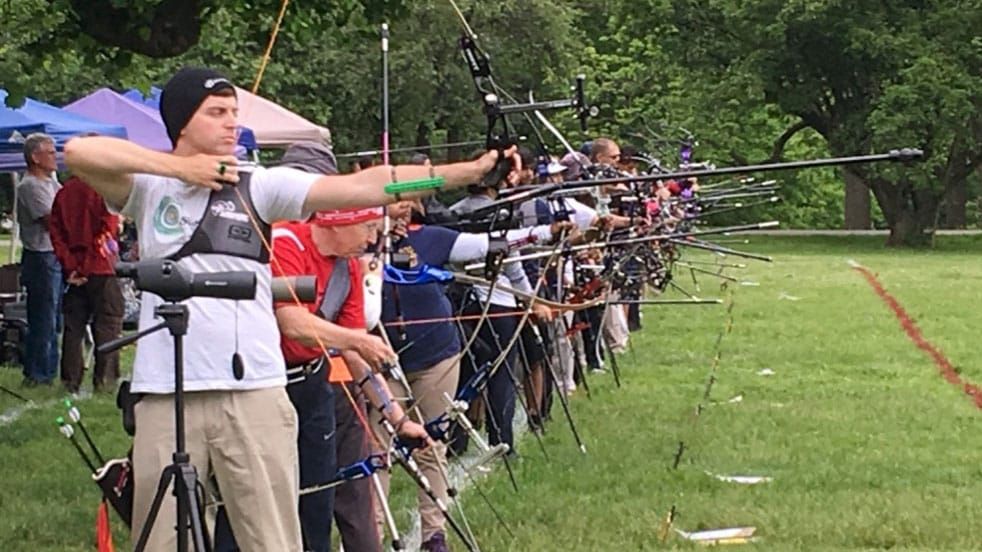
Picture the sport of target archery in your head. Roll it around for a minute. Rows of men and women in starched whites, holding long wooden bows. The formality and pageantry of the Olympics. Heroic girl-archer Katniss Everdeen. The Elfin Legolas, with his impossibly stylish hair. That portrait of David Bowie in shirtsleeves, gracefully holding on an imaginary target for Richard Avedon’s camera…
Not even close.
At least, not here in North Jersey, where on a damp fall day my son and I found ourselves on route 46, between a Spy Shop and a disreputable looking hot dog stand searching for an antidote to the suburban soccer league blues. My son belonged to a traveling team of over-scheduled boys who had signed up for soccer between Kumon and piano lessons because… the shirts looked cool. Julian was a 2nd midfielder on arguably the worst soccer team in the local Cougar league. It made for some long, damp late October mornings for both of us….
On one such morning, my son was turned away from a match in Lodi NJ because of a silly league paperwork discrepancy. I was done with it, and he was game for a distraction provided there were snacks. We were suddenly just two men of leisure, out and about on a Saturday morning with nothing to do except wait for the hot dog stand to open.
“We need a sport all our own, son…. something different… something unique” I said. It was then that we passed a billboard: “Do you need a sport all your own? Something different? Something unique? Try Archery!” All signs pointed to a cluster of shops in a small beige office complex. I had shot bows and arrows as a child. What could go wrong? …. It couldn’t be worse than soccer. I hit the turn signal.
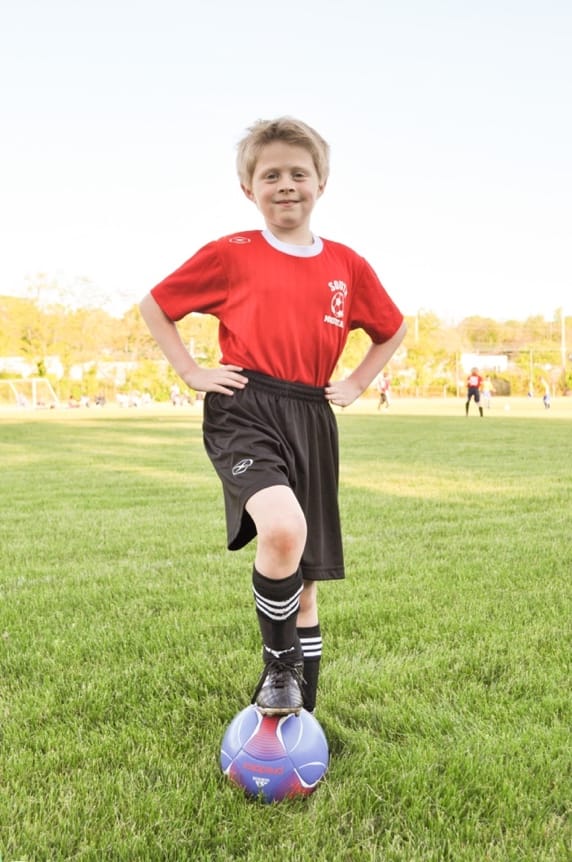
A very young-looking Julian poses with defiant soccer ball
Mankind has been practicing the discipline of archery since we could tie the ends of a string around a stick. When one bronze age civilization wanted to have a good sharp go at another bronze age civilization from far away, there was nothing to beat it. Archery may, in fact, be the world’s second oldest profession, as in the times before currency, nothing impressed the ladies like a well perforated poultry, complete with convenient arrow-shaft grab handle. Remnants of stone worked into arrowheads have been found in South Africa that date back 60,000-70,000 years. The earliest depicted archers were the Egyptians, but bowmen are rendered on decorative crockery from the Chinese Shang Dynasty and ancient Assyrians and Parthians who practiced on horseback are depicted on their respective vases and teacups. Pre-historic Native American archers are denoted in Northeastern America, as represented by dozens of archeological middens, or waste-piles, containing early slate arrow heads of all shapes and sizes based on their respective antediluvian era. This is all rather remarkable as the chances of ancient Egyptians actually having contact with the more recent North American Indians (despite Thor Hyerdahl) is debatable – implying the theory that the bow and arrow is a fundamental idea, like the wheel, or fire, or English muffins. The idea to propel a sharply tipped stick with another stick, taut with string, may have occurred in tandem throughout a variety of cultures as they progressed, once they realized they really wanted to have a right good poke at someone “way over there”. Other theories of proliferation involve brief contact between cultures and the concept that “you only have to have someone shoot at you ONCE before you devise your own means of propelling arrows.” Archery was in fact so important in the eras before gunpowder that in the decades following the Battle of Agincourt, the Parliament of England passed The Suppression of Unlawful Games Act of 1541 to stop people from, among other things, neglecting their archery skills in favor of tennis.
The first known archery competition was held in Finsbury, England, in 1583, and included over 3,000 participants, followed by a parade through London, with wine, beer and ale fueled celebrations into the night. No one remembers exactly who won. However, the concept of hole-punching to impress the gentry is older than that – it’s said that 21stCentury BC Egyptian warrior/sportsman King Amenhotep II challenged members of his court to pierce the middle of four thick brass targets with arrows fired from moving chariot, as he had done previously. It is claimed that his bow was strung so tautly that no other archer could pull it. Advantage Amenhotep II.
Archery was much more than a pastime in medieval Europe. The principal weapon of the realm, displacing the mounted knight and crossbow in the 13th century, was the longbow. Made from yew, ash or elm, and measuring the height of a man, it is estimated that the longbow could demand a pull of as much as 90-100 lbs. That’s a staggering weight to hold on target for any period of time. The skeletons of exhumed medieval archers have been noted to have elongated radius and ulnar bones and ligature from pulling such a device. To get a sense of scale of the longbow’s importance to pre-gunpowder age battle, one only need look to the 100-year war between England and France. In what must have been a muggy and fragrant summer day on the 26th of August 1346, 6000 to 7000 dyspeptic English longbowmen soundly defeated the French at Crecy, beating back 15 to 16 charges in all. The English longbowmen killed 12,000 men, among them 1200 mounted knights armed with crossbows, between rounds of crippling dysentery. The superiority of the longbow over the crossbow-bearing mounted French knights at Crecy changed the shape of warfare for generations. During The Battle of Agincourt 71 years later, an ‘arrow-storm’ of 1000 arrows were fired every second by 7000 English longbowmen. The English bowmen, Shakespeare’s “we happy few, we band of brothers,” displayed accuracy at 100 yards that proved to be deadly to the French and decisive in the course of the war. 38 years later the canon and musket wielding French took everything back again at the Battle of Castillon in 1453, ending the 100 Years War, and in many ways the age of longbow supremacy.
Archery is a “lifetime” sport. One of the surprising aspects of archery is that you are never done with it, or conversely, it with you. Because of the physics of arrow flight, a small child can just as easily hit a target 20 meters away as the largest and strongest man – by aiming up a good bit. Likewise, competitive archers come in all age groups, from JOAD, or the Junior Olympics Archery Development program to college teams and Master’s Plus. Although it’s technically a martial art, archery is surprisingly gentile, with just one injury for every 2,000 participants – making it safer than golf, or cycling, or competitive eating. Notwithstanding - archery safety is taken quite seriously. Make no mistake about it – even the simplest bow and arrow is a deadly weapon – and famous fatalities include Ötzi the Iceman, Ahab, the seventh King of Israel, William II of England and more recently, Cecil the Lion. Contemporary archery injuries occur most frequently in hunting scenarios. Target ranges employ a variety of accepted safety standards, most usually involving referee whistles to signal the conclusion of an end, or flight of arrows.
Approaching the targets between volleys, archery can be very social. The long, and occasionally disappointing walk to retrieve one’s arrows is a time when conviviality is most encouraged… i.e. “that one really got away from me…. Anyone see where it went?”. Lifelong friendships have been forged in the heat of stomping around on a field looking for a knitting-needle-thin target-arrow gone awry.
A contemporary 21st century compound bow can fire an arrow at 235 miles per hour as fired by a grown man, without much difficulty. The first time I accidently shot a hollow, carbon fiber arrow into a steel girder at 18 yards at 345 fps, the sound it made was breathtaking. When one makes that sort of mistake, it happens so fast you don’t even know the arrow has left the bow. The other archers on the range momentarily stop what they are doing to have a look. There are some cheers – like when a waiter drops a tray of lobster bisque bowls on a Friday night. The second time one accidently looses into a support column, turning arrow into something resembling a swizzle stick, people just look at you sadly and shake their heads.
The indoor range at Targeteers, on Route 46, where my son and I took our first lessons, must have originally been built for something else – which would explain the steel girders. Holds up the building, good for arrow sales. Targeteers’ indoor practice range is the downstairs half of what, to us, looked like the Devil’s Toy Shop. Rack after rack of expensive and complicated-looking bows greet you as you wander around and ponder your credit card balance. Taxidermized deer, bears and birds look on fiercely as you browse hunting arrows with multilayered, razor-sharp points. Case after case of inexplicable accessories fill every nook and walkway, decorated with small but not insignificant price-tags. Center stage are the dozens of vintage longbows and ornate wooden recurve bows for modern Olympic archery and rack after rack of compound bows.
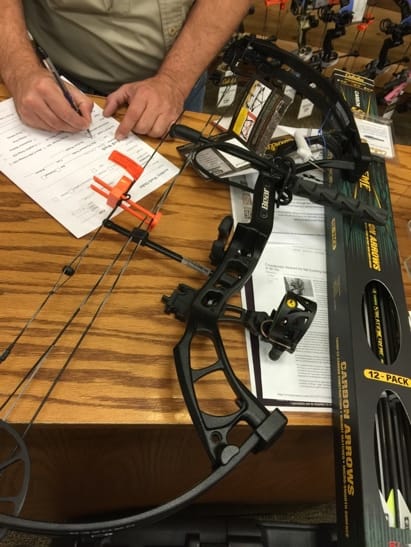
Signing up for the my new Bear Bow at Targeteers in Saddlebrook, New Jersey
On an evening visit later that week, Julian and I took our first archery lesson with One-Legged Joe. Joe explained the number one rule of archery to my son – with perfect Burgess Meredith as Mickey Goldmill delivery – in this manner: “Take my cane. Now put it in that hole in the floor. OK, where’s my cane? It’s in the hole! You know this because YOU put it there…”. We never did entirely figure out how this related to archery, but it’s been a handy maxim for finding lost items thereafter. Our first lesson with Joe included a turn on the “house bow.” A Genisis is a simple, cheerfully colored bow that pretty much every range keeps in stock for first timers like us. Genesis bows have no sight to worry about – and since Joe had us shooting at a target 7 foot wide 5 yards away, we were virtually foolproof. We cheerfully listened for the commands to “nock,” “fire at will” and “retrieve your arrows” at the Tuesday night kiddie league. Wave after wave of savage child bowmen dispensed a miniature arrow-storm with meandering intent. After surviving our first introductory archery lesson and league night, my son and I were now experienced archers, and it was time to go upstairs and talk upgrade.
Before one clinks down the Visa card on the long glass counter, one must decide to what kind of archery one aspires. There are distinct groups – with their own desires, style-cues and even politics in the world of archery. In a wildly oversimplified summary, the Olympic crowd favors recurve bows, usually ‘take-down’ styled, with a system of stabilizers and weights that can be broken down stored in attractive luggage. Olympic style recurve archery is usually practiced at 70 yards. The Olympic crowd is patently internationalist – and young archers aspire to compete for prestigious college teams.
Target compound bows, in contrast to recurve, are more technical, allowing for scopes and lensed ‘peep’ sights. Many modern compound bows feature exotic metals and laminates to fabricate the limbs, and sophisticated arrow rests. Complex pulley systems ensure that compound bows are more ‘powerful’, with vastly higher arrow speeds that allow tighter groupings. Target compound archery, although not yet Olympics sanctioned, is hugely popular nationwide. I’ve not yet met a compound archer who wasn’t also a solid backyard tinkerer. Making one’s own arrows from parts and knowing your pull weight and maximum draw-length is a necessity. Extra points are earned for learning to adjust your cam sync, do field repairs with your tool kit, advance a bow press, and even make your own strings.
Both compound and recurve bows are also popular for hunting – which has its own color scheme of Realtree camouflage. Archers who hunt have their own fiercely tipped arrows, their own language and practice style and often 3D targets shaped like quarry. The hunting culture is its own world, and since we name the visiting deer in our yard and feed our resident raccoon family Smart Food, the “eat what you kill” culture was a bridge to far for our leisure pursuits. There’s a strong, down home rural American thread that runs through the hunting crowd encompassing self-sufficiency, preparedness and knowing how to wield a deadly instrument and weigh its consequences.
To add to all this, there are traditional archers who favor ‘instinctive’ shooting with no sights or technical equipment at all. Some favor the historic longbow – which differs from recurve as the bow strings do not touch the limbs when at rest. The Japanese Kyūdō style, or the ‘way of the bow’ is a popular Eastern form of archery utilizing a spartan 2-meter bow. Kyūdō trained archers align the mind and body to an idealized physical and spiritual form where the arrow finds the target through inevitability. “Correct shooting is correct hitting”. Kyūdō masters have demonstrated this skill by hitting the target in total darkness. There are many, many steps to Kyūdō mastery, and many initiates knock an arrow only after months of spiritual training.
Naturally, as gentleman of leisure, we gravitated to the compound bows – because they looked the fanciest and had the most complicated attachments. Even the most rudimentary compound bow is a completely confounding looking thing the first time you see one. The principle is that by using a system of cams and strings, one can achieve a great deal more torque from pulling back a bow than one can achieve with a simple single string and laminate affair. The additional bonus of compound archery is that a compound bow pulls to a set point, called draw length, and then achieves ‘let off,’ which allows the archer to hold on target at a small percentage of the actual draw weight of the bow until it’s time to release. This is a huge advantage, as a 40 lb bow will hold at 10 lbs if properly set up.
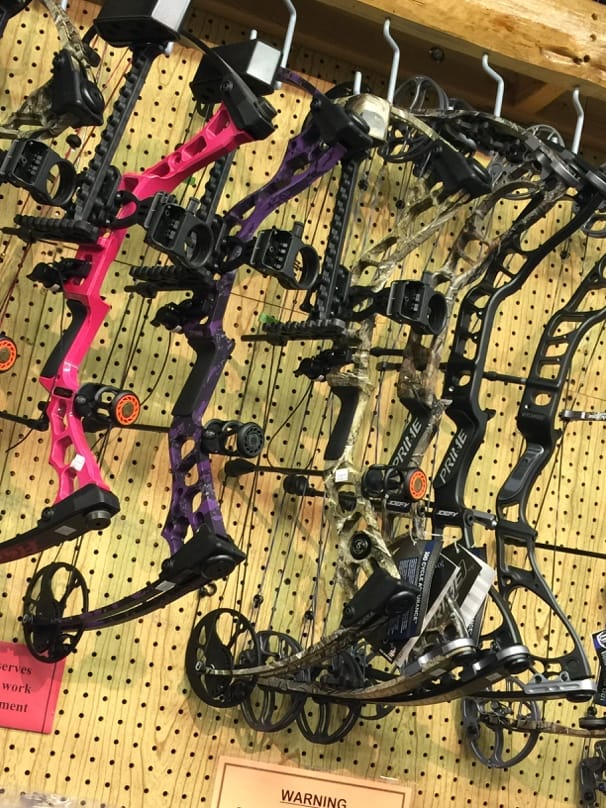
Rows of tinkery compound bows for sale at Targeteers in Saddlebrook, New Jersey
With One Legged Joe’s cane-centric instructions filed away in our heads, and properly equipped and indebted, Julian with a junior sized but lethal looking Hoyt Rukus in target red, and me with a slightly larger Bear Cruiser in a stylish black scheme, we were officially archers. We were armed to the teeth with bows, arrows, sights, more arrows, releases, straps, luggage, tee shirts, visors and etc. No spiritual training for us!
The Great State of New Jersey has relatively relaxed laws governing bow and arrow use by private individuals, both for hunting purposes and for leisure-quests such as ours. For hunters, bows must maintain a minimum draw weight of 35 lbs., and hunting arrows must be fitted with an arrowhead of “well-sharpened metal at a minimum width of ¾ inches”. Crossbow hunting is legal in New Jersey, provided a draw of 75 lbs and a stock length of greater than 25 inches. Backyard ‘target’ archery is allowed – but disputes between neighbors are common enough to warrant discussions on local forums. Banned items listed in our local regulations include shooting 30 minutes after sunset or before sunrise, poison arrows, arrows with explosive tips, or using a bow and arrow from a moving vehicle. Sensible.
Those of us without level, large backyards and forgiving, housebound or absentee neighbors need to find places to practice. This proved to be a huge part of the journey for us – as schools of archery in New Jersey are as diverse as styles of archers. Some archery schools are quite ‘formal’ and instill a high degree of Olympic discipline to their students. Some are more rural and loosely enforced. Some, as we found to our satisfaction, are informal, suburban, and feature plentiful snacks. What we needed was a peer group.
The Bloomfield Archers has, according to its website, been in operation in Brookdale Park since 1931. Brookdale Park is a 121-acre gem that spans the border between Bloomfield and Montclair and was designed by the Olmstead Firm, the same folks who designed Central Park. Brookdale was once a gathering place for the Lenni Lanape Indians – who would likely approve of the archery – but has branched out to include tennis, handball, pickleball, baseball and soccer spaces, as well as a pavilion, stadium and grandstands. There are concerts there in the summer, dog walkers, and hundreds of joggers. There are ice cream trucks. There is easy street parking. And there are archers.
To put this in perspective – imagine what kind of insurance one would need to allow hundreds of people to fire off arrows in a small corner Central Park whenever they wished, maintaining an archery hutch and storage shed based on the ‘honor system’. Incalculable. That’s one of the wonders of the Bloomfield Archers – they have been there SO many seasons that they are ‘baked in’ to the equation by Essex County. It’s said that if one dug down several feet, one would still find arrows, due to the shifting of the earth over almost 100 years of continuous use by all manner of projectile flinging sportsmen. One day, someone will dig up that field, mistake it for the location of a great battle, and wonder, since all the arrows face south, what the other guys were shooting.
Compound, recurve, longbow, traditional, and even crossbow competitions happen seasonally – including the Bloomfield Gold Cup, Garden State Games, Outdoor Nationals, Senior Games, National Crossbow Championships, and several National and Olympic qualifier rounds. These events draw well known and nationally ranked teams to what is a bucolic and charming vista. It’s been called one of the most beautiful archery fields in North America.
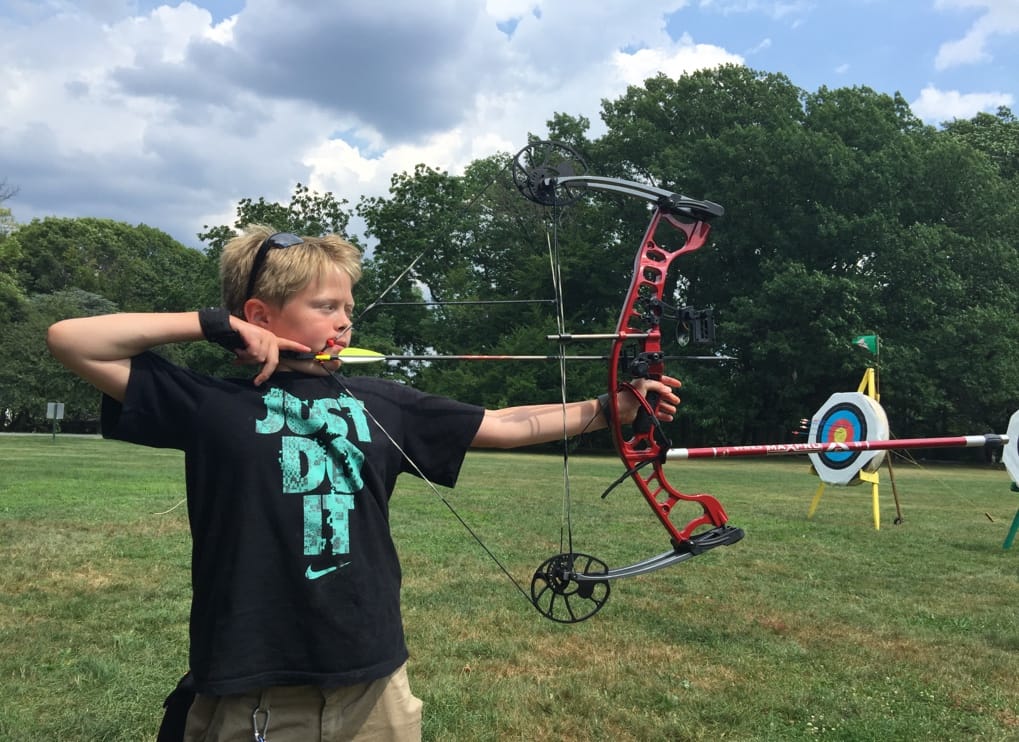
Julian holds on target at Brookdale Park, in Montclair New Jersey.
Joining the ranks of the Bloomfield Archers is a relatively straightforward affair. One needs to take a membership in USA Archery, the national governing board, to participate. A nominal cost. The first person you will encounter as you arrive at an Open Sunday of The Bloomfield Archers is a gentleman known Dutch, nee Ralph Eckel. With a shock of white hair, khaki colored ball cap, thick glasses, full mustache and pipe, and festival of vintage leather waist pouches, Dutch is local legend, a Vietnam veteran and a member of the Brookdale Archers since 1954. Dutch has seen them come, seen them go, and seen them come back again. His is a love/hate relationship with the activity that has defined his weekends since childhood, and frequently he can be heard muttering to himself such personal maxims as “Oh God, this is such a stupid sport…” as he mentors the young archers that flock to him on Saturdays and Sundays for his introductory classes.
Deep down, you know he loves archery, sort of, and can’t give up on the club that has been his weekends for 66 years… Naturally, come every April, the worry is that some local government busy-body will come to their senses, squash the club’s application, and reclaim the field for some other, saner purpose – so Dutch’s role as holder of the insurance certificate, advocate and spiritual leader of the club is very important to its existence.
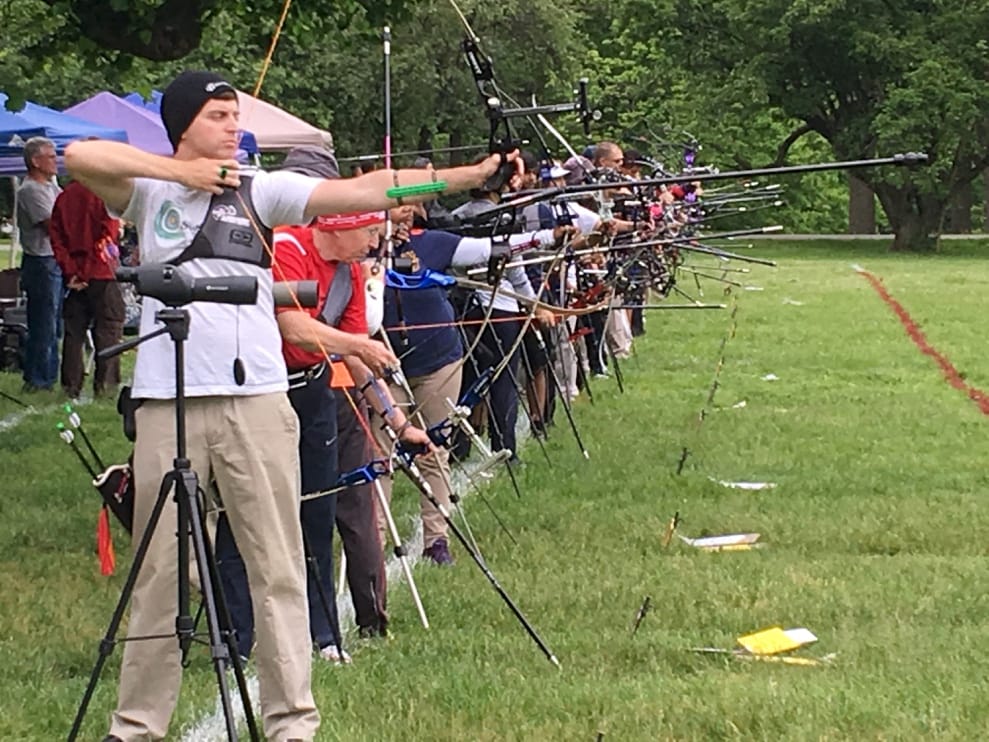
Archers hold on target at Brookdale Park in Montclair New Jersey
Using all our knowledge, and every bit of our muscle memory from our sessions with Joe, we passed the perfunctory skills exam at Brookdale Park and were permitted access to the field house. This was a HUGE step up for us. We were not just archers, not just Defenders of the Realm, but card-carrying archery club members. We had a peer group! Julian had other young archers chat with. We were permitted to set up target stands and practice, weather permitting, on the archery field during daylight hours whenever the mood took us. My son and I could register to participate in the many seasonal archery meets – a great way to assess our fledgling skills against other archers and see all the latest equipment and outdoor furniture that the flocks of archery families set up every weekend. We became experts in what time of day to visit to avoid the mayflies, the June files, the July heat, the storms of August, the cold rains of September. We learned the ways of the bow. We learned which pizza places delivered to the field. We learned a lot of humility too, as we regularly had our clocks cleaned by 80lb tween girls, pulling candy-colored bows who score 10X after 10X effortlessly. My son and I got quite good at looking for lost arrows – the club maintains not one but TWO metal detectors for probing for the steel heads of lost arrows that disappear without a single visible trace beneath the turfy pitch if you misjudge your shot, sneeze, or just mentally wander off. Julian and I spent many happy evenings figuring out our new bows and honing our skills that summer.
As fall turns to winter, The Brookdale Archers have a sister club for the colder months in WO-PE-NA Archery of Clifton New Jersey. Every November, Dutch, our ambassador from Brookdale Park, locks up the archery hutch for the winter and with a grumble, turns his attention to shepherding his flock the 10 minutes up the Garden State Parkway to Clifton. WO-PE-NA is one of the ‘historic’ archery clubs of New Jersey, established in the 1940, and competes in the Mid-Atlantic indoor tournament schedule along with sister club and frequent rival club WA-XO-BE in Monmouth Park. As a note: WA-XO-BE is pronounced: “Wax – A – Bee”, Which, for my son and I is accompanied with a hand gesture indicating waxing a car, and a vocal bee ‘buzz’ sound… followed by endless laughter … to this day. If Brookdale was our archery peer group, Wo-Pe-Na would become our New Jersey archery family, and Julian’s de facto ‘first men’ other than parents, teachers, and fathers of friends.
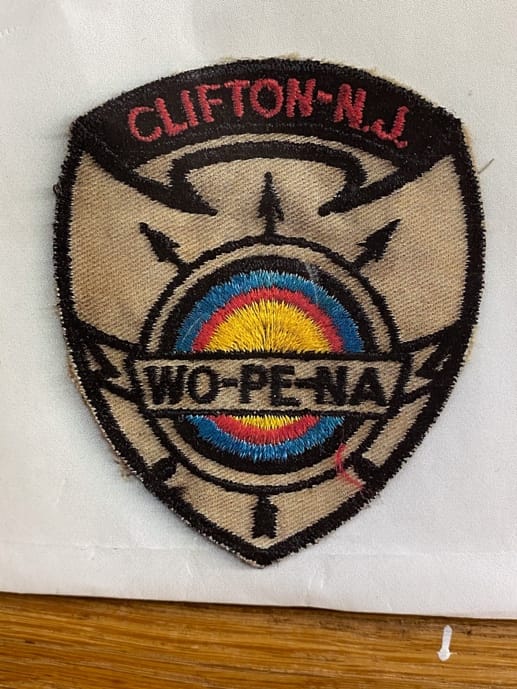
Wo-Pe-Na Archers was founded in the 1940s in Clifton New Jersey.
When Harry Miller, WO-PE-NA president, holds his bow on a target, it’s like watching an oak tree branch on a windless summer morning. There’s the stillness, the implied strength of his arms, torso. The man is a tree. He shoots lefty, so if you’re shooting from the center lane, he on your right and often he’s the only archer facing you. It’s unnerving. I think he likes that, if you’re competing against him at Thursday night league. He doesn’t seem to breathe…. at all…. for a good 10 seconds. A trap shooter by training, no doubt he’s battling the same things all archers do. The target yellow and red alarm bell that rings in your head when you’re hovering on in the 10x ring. It’s called Target Panic. Adjusting its volume so you can release exactly right – with a perfect pluck that sends the arrow spinning on its arc to the center. “Archery is backwards sport”, Harry often says, the only sport where you use your back muscles to pull away from the target… pulling through the shot.
At 18 meters, the X ring of a 40cm Vegas target is the size of a dime. Indoor equipment is different too, as archers often choose to change their arrow diameter for indoor competition because a larger diameter arrow has a greater chance of touching the dime sized 10-point bullseye – and indoors, there is no cross wind to upset its hefty, slow flight. This requires a whole new set of tinkery arrow rests, peep sites, fancy scopes and leveling glass. To score anything *like* well, you need to be able to hit that dime most of the time. Champions of compound target archery can hit the coin over and over again, scoring multiple 600 rounds that often lead to playoff, after playoff, after playoff, until the alarm bell in someone’s head gets too loud, or their blood sugar gets too low, and they waiver. They ‘wander off’ and ‘rip one’… and then it’s over. The center ring is the natural order of things – it’s not that hard to find it, with an 8x scope and a lenticular peep site on your string, at almost 60 feet. It’s not even hard to hold on it, if your bow is carrying 36” carbon stabilizer, weighted side bars, and tuned so that your ‘back wall’ let’s you pull the bow grip back against your left palm, resting at an even 10 lbs. holding weight. What’s hard is to get your body to release the arrow because of the alarm bell ringing in your head, and have the arrow make its 300 feet per second flight down the lane and ‘whump’ the target bale for true. It’s an alarm bell we all hear, because we have to hear it, to make a perfect, smooth release that touches the center ring and scores a 10. That alarm bell is partly fear – a little spike that reaches down into your chest and touches every doubt you have ever had about yourself…. are you a champion? Are you worthy of the center ring? Can you stare into the sun? For how long? Do you deserve the center ring, over and over and over again?
Martha, the Suburban Galadriel to the lost boys of the WO-PE-NA Archery Range, established 1949, right here in this misbegotten and occasionally damp basement in Clifton, says she likes to imagine her arrows arrow pass through, and not into, the target. Their actual destination is further along a continuum of the arrow that circles the world – and in this way she effortlessly wills her arrow to go through the target – a ‘true hit’. It’s her way of beating the alarm, the blood sugar spike, the fear. It’s her way of wiping her mind clean. It’s the way of the bow. It’s what keeps you coming back.
Most people who come to WO-PE-NA have found archery by accident. Martha – also a writer and anthropological researcher, wanted time away from the house and a new, interesting group to explore. Julio, the FedEx driver, who spent his first year trying every different kind of bow imaginable until settling on ‘longbow instinctive’ shooting, found the range by accident while making a delivery. Famously, once, he called in late for a competition because he “was stuck in Bayonne with a load of nuts.” We still say this in my house occasionally. Julio comes in his Fedex shirt, sometimes in his truck full of packages. Mike, an ageless octogenarian who travels the country to archery meets and competitions taking orders for his mail order bows, parts, arrows business in his stylish porkpie hat. Benny, septuagenarian Puck to Harry’s Peter Pan, does all the heavy lifting of organizing the club, tracking the dues, occasionally keeping crazy people from getting a deadly weapon in their hands, organizing the security cameras and paying the bills. Grown adults playing bow and arrow in an endless round robin of rules, traditions, blasphemy, diet ginger-ale, squabbles, tinkering, pecan rings and questionable Chinese take-out.
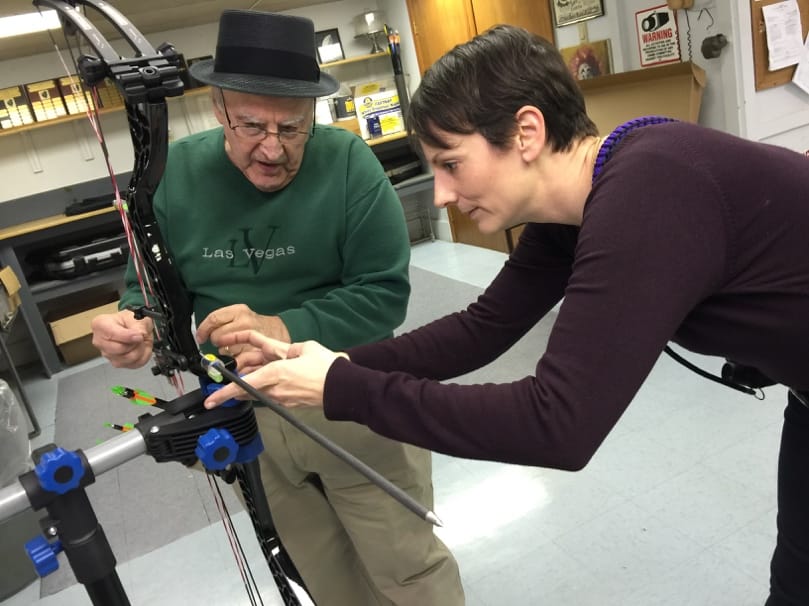
Martha and Mike tie a knocking loop on my bow at WO-PE-NA in Clifton New Jersey
Julian grew to know all these men and women, their moods, their strengths and liabilities. These were his first adults – and a completely different experience than the strict “coach, referee, dad, player” roles at the soccer games. It was pretty wonderful to see him navigate the room, sizing up who was easy to talk to, who was more challenging, and who might actually be vaguely involved in organized crime. We were, after all, in Jersey.
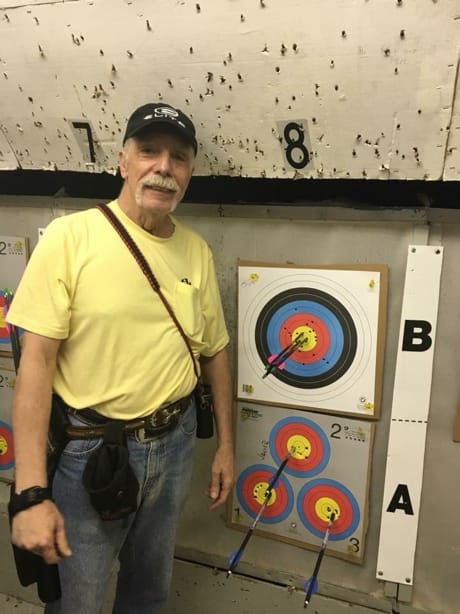
Benny overcomes target panic at WO-PE-NA in Clifton New Jersey
When the phone rings, usually on Sunday, with a father or mother inquiring about the range, it’s Benny who answers. Benny has a lot of good stories, and by God, he’s gonna tell them. A rangy ex-railway man, Benny has been electrified once or twice. He went all the way to the other side, and just as they were reading the rights, he came back. Probably finished his shift. A natural welcoming voice for the club. Benny suffered from target panic for 2 years, and only now is back to light competition. When the alarm bell gets too loud and you can’t stare into the sun long enough to release your arrow, you sit out a season or two. You have to practice holding on the center of the target. Harry calls it “getting your target visualization right”. More reserved than Benny, and with a Northern New Jersey accent that will ring in your ears, Harry restores Corvettes at his service station in Bloomfield. A lifetime of turning large wrenches will give you steady forearms. Harry earned his fortune during the heyday of printing in the 70s and 80s. ‘All gone’ he says of the once booming business in North Jersey, but he got out, with some patents under his name, and opened up a trap range with his wife, Pam. When the shotgun blasts and responsibilities of turning a hobby into another business became too great, he came to Clifton for the way of the bow, for the bagels, for the tinkering. Harry has a lot of fancy late model bows in his club office. More than fit properly. All lefties. When the Lancaster Archery catalog comes it’s Harry Miller’s name on the front. If there’s a new kind of 27mm, ‘edge of legal’ 300 spine arrow you have only just read about, it’s already in Harry’s office.
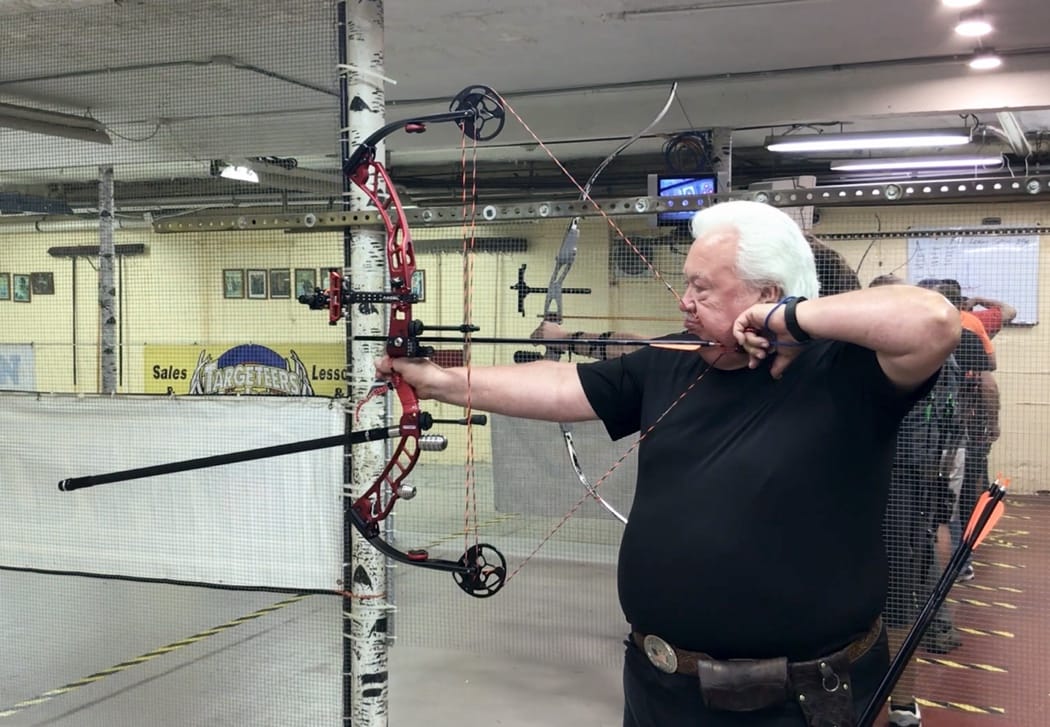
WO-PE-NA President Harry Miller holds on target in Clifton, New Jersey
The feel of an archery club borders on church basement earnest. You could hold an AA meeting at WO-PE-NA and the teetotalers wouldn’t feel out of place. The Bun-O-Matic coffee machine, the cinnamon rolls, the fellowship, the hospital yellow flat interior latex paint. There is a sofa setup and TV, for hostage moms whose rising stars are tuning out the occasional profanity on the firing line and dreaming of preferential college admission. There’s a fridge that has last Sunday’s bagels, the flavors no one wanted, as well as industrial sized cardboard boxes of butter pats and Philadelphia spread. In addition to vintage wooden bows, antique hunting arrows, sponsorship signs, for sale signs, etc, there are dozens and dozens of photos on all the walls of Wo-Pe-Na. Black and white faded prints of lines of men and women, some long forgotten, in starched whites. Past club presidents. In memoriam, Artie Mazzone – who proceeded Harry as president, with various students, holding a bass fish he caught, shooting a Bear hunting bow outdoors with a much younger Mike. Harry teaching a young Jane Box, who completed and won nationally her first year out. There are classified ads and fliers for Mike’s bows and parts business, knot tying guides for making release loops, and endless shelves of member’s stored bows. There’s usually at least one lingering construction project going on.
Between the men, there are all manner of trades, so replacing tiles, pouring concrete, electrical work and plumbing are all done in house. Many of the archers have experience as tradesmen. It wasn’t till there was a bad lighting fixture one Sunday that I had ever seen anyone work on a fuse box without shutting off the power, by example. “When the hair goes up, the job is done” said Benny as Harry wired up a 20-amp breaker, one handed. This was another thing that Julian was learning from firsthand observation. People had different skills that were useful, and sometimes the humblest member of the tribe was the one who knew how to get the sink unclogged properly. In time, Julian learned to use tools and mend bales, repair his own arrows, and fix the sink. Julian was becoming more self-assured in the company of adults from outside his circle. Eventually, Julian learned to mimic all the New Jersey accents at the club – flawlessly. Once when caught being casual about his scoring, he and Harry got into a debate. Julian apologized. Later, when Harry overheard us discussing their conflict, it was impossible not to notice the smile on Harry’s face when I told Julian that this was what being in the “company of men” was like. He was becoming a young adult. He was becoming a member of a larger tribe not tied to his school, or his home.
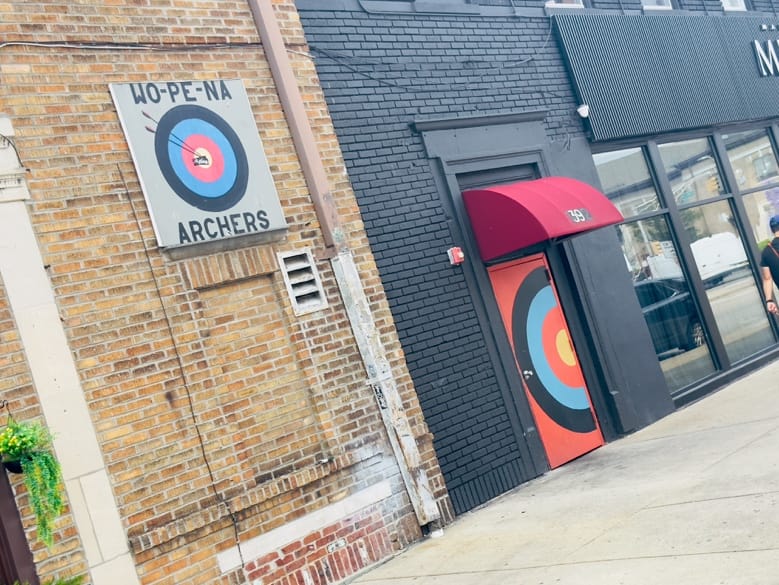
WO-PE-NA Archers target colors door in Clifton New Jersey
Hang around a barber all day, and eventually you’re going to get a haircut. Hang around an archery range all day, and you’re going to participate in an archery tournament. Measuring your skills against other archers is part of the deal. Robin Hood was a better archer than the Sherriff of Nottingham. It is known. And so it has been throughout the centuries…. After a winter of tuning our bows, endless practice and “Bagel Shoots” on Sundays, it was time to find out if we were getting better…. since it was time for the USA Archery New Jersey State Indoor Championships held in early spring.
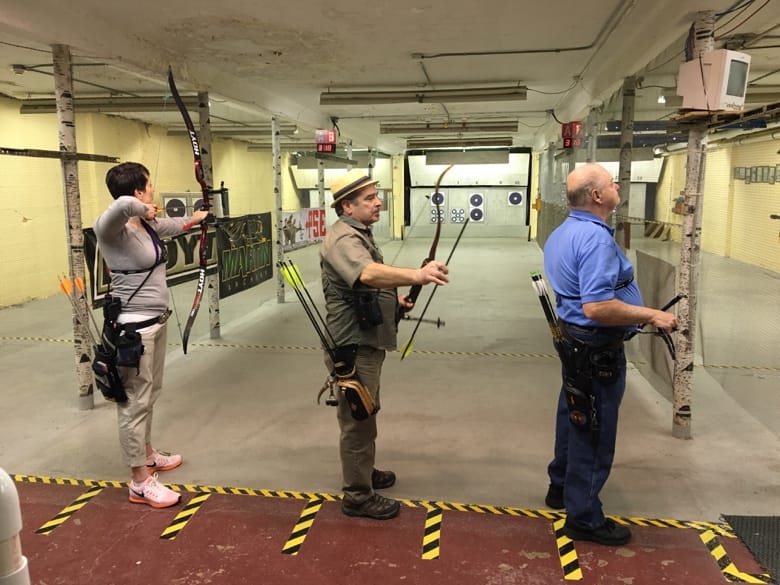
WO-PE-NA League Night, Martha holds on target, left, in Clifton New Jersey
Tournaments are as much social events and swap meet as they are opportunity for actual archery greatness. My son and I had been practicing three times a week, plus Sundays, for months, in preparation of paying our $35 entry fee, and standing on the line with the other, more experienced competitors. My son would be shooting ‘Cub’ on the 10-meter target, I would be shooting with the adults at 18 meters. Phil, resident philosopher of WO-PE-NA, runs a dry cleaner and preaches from his stool on Sunday mornings. He had noticed Julian and I practicing on the Vegas Targets during the Sunday morning meetup – which would be used the following weekend for the New Jersey State tournaments. Free Archery Advice, worth every penny, is a hallmark of archery ranges – but Phil’s advice was usually spot on – so we paid attention that day…we needed all the help we could get. “You’re not going to win next weekend…. Or even come close” said Phil, having observed our skills for a few months. “The best you can do is not be branded an asshole… and not do anything embarrassing like shooting the ceiling or blasting an arrow through your own scope”. “Also, wear collared shirt and slacks”. “For real?” Of all the things I learned in advance of our first competition, this was the most surprising. There’s an enforced dress code for the State Championships. I had never seen anything but FedEx uniforms, jeans, cargos and *legendary* track suits of New Jersey since my first visit to the basement. Phil explained: “Tournaments are special. There will be visitors. We take out the trash, do the dishes, make sure there’s extra coffee. Don’t piss anyone off. Especially if they are wearing camouflage and shooting instinctive style with a hunting bow….”
WO-PE-NA plays host to a half dozen competitions a year, always on weekends, starting on a Friday and carrying through until Sunday nightfall. The range is closed for regular business, and champion archers from around the tri-state descend on Clifton for the plentiful street parking and storied pizza options. Local archery heroes like the Staten Island teenaged sensation Sachiko Keane and the one-time national champion Matt Setzer would be competing this weekend. Our little squad from WO-PE-NA would put on a good showing too – Luiz Silva, who owns a beloved bakery in Ardsley NY, would be competing, fresh from a solid showing at the Lancaster tournament. Scott Hale – who paces Harry on weekends, had been working out for weeks with some new arrows. Mark Natale would be proctoring and refereeing the shoot days – a great responsibility – and Mike LePera would be running the line buzzer and keeping the score cards straight with Martha, who was quicker with scorecard math than anyone else in the club. Dutch, our old friend from Brookdale Park, would be on the PA calling the shots.
Indoor archery tournaments are usually 20 flights of three arrows, for a maximum score of 600. A maximum score per round is 30. A decent round for us is 27. A 24 will dent your final score. Rip one flier, miss the target, and you’re into the teens for that round. Standing on the line, lefty Harry Miller facing me, shooting 30 after 30…. with years of archery tournaments under his belt. Daunting.
I had shot my first 10 rounds and was someplace in the middle of the pack, when I encountered my son in the kitchen during the protracted ‘half time’, during which coffee rings and danishes are addressed with some ceremony. “I’m in the front of the pack for the Juniors” he exclaimed. As it turns out, tournaments are structured by age and to his benefit, he was one of the only cubs in his age group. Helpful. I was pretty far off the pace in my larger adult group. It’s a whole different experience, shooting inside the 2-minute bell, than it is in practice, I told my son, by way of explanation for my mediocre performance. He agreed. The hardest part is recovering from a bad shot, as you know it’s lowered your overall score considerably. Truth be told, I was sharing a lane with a 16-year-old girl who proceeded to humble me, dropping 10X after 10X while casually texting her girlfriends in between rounds on a sparkly iphone.
At the end of the weekend, my son came in 2nd overall in the Juniors, I was someplace in the middle of the adults. Archery tournaments are very generous with certificates and medals, and the middle in my age group was a third (perhaps out of three). I was going to get a small medallion! The first of many “third of three” medals I keep in a drawer in my home. The middle was fine by me – I had avoided shooting out my own scope, or hitting the ceiling, for 60 entire arrows. I had competed, participated in the ancient game. I had bravely stood with centuries of archers before me. My son had a solid showing and was ensconced in the world of competitive archers. It had been a good day. Olympic greatness was in our reach.
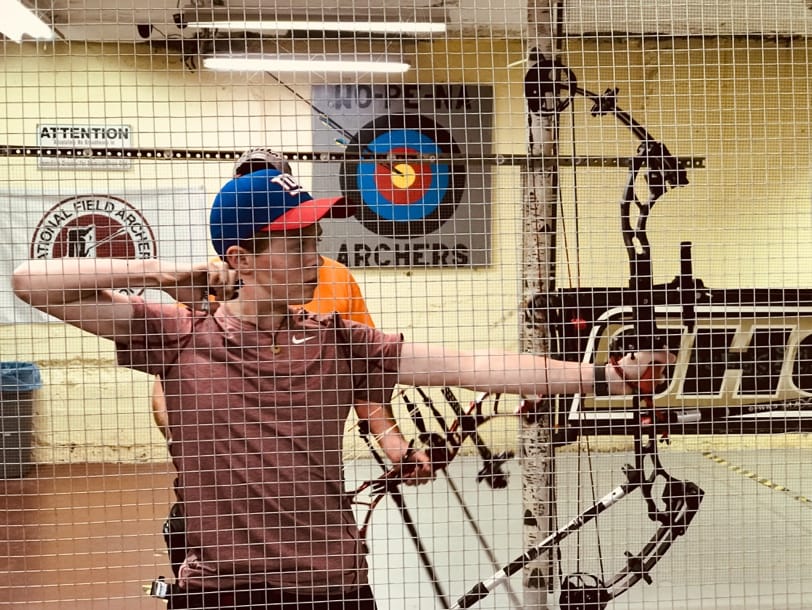
Julian a year older pulls through the shot at WO-PE-NA in Clifton New Jersey
At WO-PE-NA, what we learned was more than just the way of the bow. The real nuts and bolts of holding on target and releasing through the shot was certainly part of it. We learned how to make our own arrows, a necessary skill if you occasionally loose one into the wall. But this journey was also my son’s first encounter with adults who were not his family. His first encounters with a tribe of adults who we’re not constrained by the formality of school or the dreaded soccer – or much formality at all. Julian learned how to judge people’s moods, when to stand up for himself, when to apologize. He met all manner of archers from the gentle, to the fierce. He learned how to be a club member – to help when help was needed. He learned how to lift heavy things. He learned not to leave the bathroom door open. He answered the call during the great basement flood and spent a day sweeping the water into the drains and rescuing all Harry’s bows from the office to higher ground. In time, he learned to lose gracefully, to win occasionally, to accept advice, to listen, to give advice to newcomers. This was worth the price of admission. This was why we came. Perfect shooting is perfect hitting, indeed.
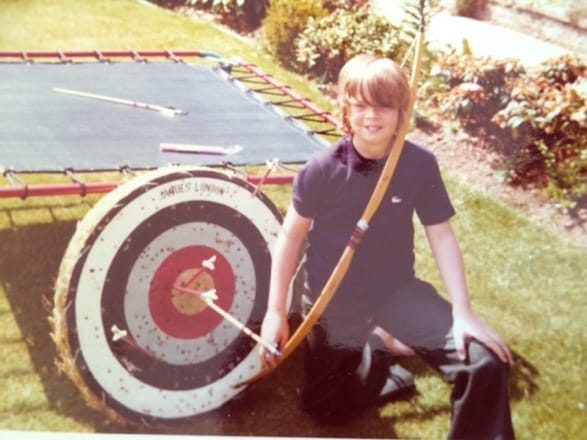
A very young me with my longbow and first taste of the gold in Moor Park, England.